
The Long-Term Impact of Building An Upside-Down Pyramid – Part 1
The upside-down pyramid can be a very profitable approach to workload/capacity utilization for small firms (under $1 to $2 million in revenues). However, it will become a significant barrier to success as a firm grows. As the firm continues to expand, loading more work into the upside-down pyramid, it will likely then morph to a more dysfunctional hour glass shape, and if not corrected, then to an even shorter and narrower upside-down pyramid. As firms progress through capacity models, at the point when the partners and managers start to burn out or the senior partners start seeing a near-term horizon to retire, they commonly either see the error of their ways and begin the required painful shift to establishing a right-side up pyramid or recognize that the journey is too foreign and uncomfortable to make so they decide to merge with another firm to let them fix the problem. So, how and why does this happen?
For decades the vast majority of public accounting firms have had the luxury of experiencing both sustained growth and an expanded scope of service offerings. Whether a firm is first being formed, or it is launching a new service, the workhorse of that operation is either a partner, or someone expected to soon become a partner. In the early stages of a new firm or new service offering there is typically less demand for services than what would consume all of a partner’s time. During this incubation period, the partner typically will use his/her untapped time to network, talk to clients and referral sources and generate more business opportunities while also taking steps to improve the business. But with time, demand will likely continue to grow and at some point will max out the capacity of work that the partner can handle. During the early stages of being a new firm or launching a new service, firms tend to default to using these seasoned people to both manage the work as well as to do the detailed work.
As the client demand grows beyond what the partner can handle on his or her own, the firm (as well as each partner) picks from two common choices for resolution. The first approach is to hire professionals and pass as much work down as possible to free up as much partner time as possible so that the partner can revert back to a more balanced capacity where he/she had time to both do some of the work, but also perform other critical partner-level activities (client relationship management, enhancing the business, improving processes, developing people, etc.). Under the second approach, the partner may choose to remain being the workhorse on the projects coming in. This allows the partner to focus on doing rather than managing, and he or she can also save money by hiring and developing less talented people since all of the high-level work is horded by the partner. This second option is the one most often chosen because it is far easier for a partner take on the title of partner but do manager-level work rather than having to fulfill the entire job of a partner (which also includes client relationship management, creating strategy, working on the business rather than just in it, developing people, etc.). Although this approach where partners do manager-level work can be profitable in the short term, it trades off more desirable long-term profitability, sustainability and leverage.
Since I just introduced the term leverage, let me introduce our definition for the sake of this article. Let’s say a partner has a $1 million book and that partner bills $300,000 for his/her time working on that book. If he/she is the only partner working on this book, the way we calculate “leverage,” the number would be 3.34 ($1,000,000/$300,000). However, let’s take a more realistic look at what typically happens. Let’s add “Junior Partner 1” spending $150,000 of billed time on that same book and “Junior Partner 2” billing another $75,000 for his/her work. Since our leverage calculation includes ALL partner time against total book, in this case, the leverage ratio would actually be 1.9 ($1,000,000 / ($300,000 + $150,000 + $75,000)). Poor leverage simply means that too much partner time is being spent getting client work done. And although either approach creates bottom line profits, once a partner’s time is all eaten up because of too heavy a charge time load, then the firm’s growth, client relationship development, internal improvement, people development and strategic change all stop because there is no time left for partners (the only ones who can do those jobs) to carry out these critical partner responsibilities. The poor leverage model also carries with it the added dysfunction of either requiring more partners to be brought in early (because a partner maxes out their volume of managed client book at low numbers like $600,000 - $750,000 instead of what we look for today being an average of about $1.5 million) or because all of the capacity of the partner is eaten up doing the work, the firm stops growing since there is no time left for the partners to fulfill one of their key roles of business development. Partners with poor leverage simply spend all of their time working in the business rather than on it which translates to a routine of very little additional profits being made available to support the firm by too many partners managing too small of a book.
So, from a workload perspective, how does the upside-down pyramid work? Its culture starts with the premise that the lion’s share of the firm’s income should be generated by its partners and managers. As I stated earlier, when you are smaller, this philosophy is not only logical, but practical, since partners are the first workers in the firm. Therefore, a culture evolves supporting the idea that partners and managers should be very hands-on and involved in the detail work of most client projects. The workflow hierarchy or the 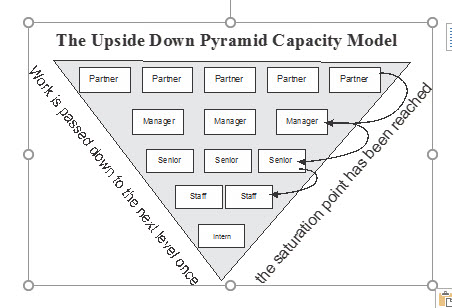
utilization of available capacity is a trickle--down approach. Partners do the technical work until they have worked all the hours they can stand, and then the excess trickles down to the managers. Then the managers, while simply mimicking their successful bosses, do whatever technical work is available until they have put in all of the hours they can stomach, and then they allow the overflow to trickle down to the supervisors, with the process continuing in this same fashion down through the lowest level or staff or interns. In each case, regardless of where someone is in the organizational hierarchy, there is low to no priority to keep everyone below them working. Rather, delegating work down through the org chart is more of an afterthought. It is as if the people in these firms believe that the subordinates 1) are employed to do the work that their superiors don’t want to do and/or 2) are considered to be “gofers” kept on standby to provide assistance when needed. By utilizing this capacity model, partners and managers tend to be overworked and staff is commonly under-worked, poorly trained, often performing marginally as a group and generally ignored.
The upside-down pyramid will, as a firm continues to grow its top line, harm the profitability and long-term viability of the firm. For example, instead of pushing work down to the lowest level possible, the exact opposite is done. Work is performed by the most experienced person possible. While one could surmise that this approach would garner higher fees (because the work is performed by people with higher billing rates), most of the time that assumption is wrong. For most of the work we do in CPA firms, our total fees are either fixed-in-fact or in-presumption. Obviously, fees are fixed-in-fact when a specific project price was specified. The fees are fixed-in-presumption when we do recurring work, like annual tax preparation, and the client will assume that this year’s fees will be within a reasonable range of those charged in previous years (unless the scope of the work changed). So, regardless of who does the work, the overall fees are likely going to be about the same. But as mentioned above, the problem is, when you tie up partners doing work managers can do, then partners won’t have time to do the partner work that is critical to the firm’s long-term success. So, while high partner charge hours will likely create excess short-term profits, the partners will be trading off the future of their firms by not regularly spending enough time with clients and referral sources (which is how firms create tomorrow’s organic growth), developing their people (which is how firms create tomorrow’s leaders and technical capacity), improving business processes (which creates tomorrow’s enhanced efficiency), creating and implementing strategy (which generates a more competitive firm in the future), etc. So the key is to get each level of worker in a firm’s organization, starting with the partners and working down throughout the firm, to do their jobs – their entire jobs -- not just the easiest parts of their jobs. And because we commonly find that firms don’t hold people accountable to doing their full jobs, partners end up spending too much of their time doing manager-level work, which then means that the managers will spend too much of their time doing work that should be done by supervisors, and this “working below your level” cascades all the way down through the organizational chart.
Because of the high value put on production at the top in the upside-down pyramid capacity model, over time, as the few self-starting, self-teaching, self-motivated people hired move up in the organization, the upside-down pyramid degrades into an hour glass shape. 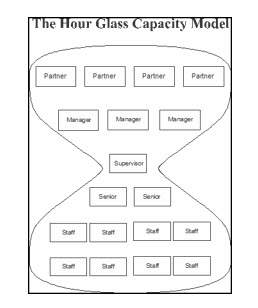 Anyone that is any good, or anyone that a partner has come to rely heavily upon to assist them in taking care of their clients, is quickly moved up in the organization. This creates a top-heavy organization with almost all of the work being done by equity partners, non-equity partners and maybe managers. The constriction in capacity in the hour glass model is typically found at either the manager level or the supervisor level with the firm (sometimes at the senior level). This means that even when the more senior people try to push work down, there is truly a huge capacity shortfall at one or two levels in the firm, which then generates reverse delegation (the phenomenon where work is delegated down and shortly thereafter, delegated back up because there is no capacity available to do the work and it is perceived as too complex to skip down multiple levels). This puts even more pressure on the top to perform. It is common to see firms where the top two or three levels in the firm have to work more hours each year to maintain their current standard of living because as expenses keep rising, that means the top levels need to bill more and more time just to stay even.
In both the upside-down pyramid and hour glass capacity models, a cultural hurdle to overcome, which for many is one they are unwilling to face, is realizing that with each promotion to a higher level in a CPA firm, it becomes more important what you do with your non-charge hour time than your charge hour time. Don’t misunderstand us. We are not saying that charge time doesn’t matter. Rather, at the lowest levels in the firm, people should be charging almost all of their time because doing client work should be all they do. With each promotion, a little less of the job is about doing the work, and a little more of the job is about managing and developing others. By the time you get to partner, a good charge hour range is about 900-1,100, but that presumes that there are very specific firm-wide goals and objectives driving the focus of a partner’s remaining 1,200 to 1,500 hours. The cultural clash that occurs when partner and manager production is so highly valued is that critical objectives like spending time developing others are considered low value work. This is supported by comments such as, “If I were to give this work to someone below me, I would have to spend so much time supervising them on the project that it is just quicker to do it myself. Besides, I simply don’t have the time to do this.” Our response: “Both the roles of partner and manager are based on the philosophy that you are supposed to get the work done through others.” As a manager, that title is exceptionally descriptive of the job – to manage. Otherwise, the title would be “doer.” So, we suggest the next time you hear yourself or others utter words such as, “It will take too much time to train my people to do this,” then stop right there and remind yourself, “Hey, while it may take longer, my job is to train them so that they can do this work. And if I don’t train anyone to do what I do, I will likely end up having to work more and more hours just to make the same amount of money.” By the way, another classic reaction from both the upside-down pyramid and the hour glass capacity models is that employees rarely get enough feedback and coaching on their work, partially because of the lack of time again. Instead of the reviewer sending back a list of errors for the originator to fix, the senior people just efficiently correct the project so they can get it out the door, but ineffectively walk away from an opportunity to train their people to make them better. Over and over, these two capacity models support the inaction of developing a better, stronger, faster staff, putting more and more pressure on the partners and managers to perform the work, which eventually creates significant problems for firms to overcome, including workload compression and the lack of profitability, sustainability, and succession.
We will pick up here for the next articles as we start talking about steps to take to fix either the upside-down pyramid or the hour glass capacity models.
Download
| File |
|---|
| The Long-Term Impact of Building An Upside-Down Pyramid – Part 1 |

We help organizations implement their unique strategies by:
• Working with them through the tough issues, and
• Customizing responses to address root causes, rather than merely treating symptoms.