
Developing People Faster Takes a Different Approach
Reversing the Upside-Down Pyramid
During the last few decades, public accounting firms have dramatically expanded the scope of services they offer. Many of these services have been in specialty areas, aligned with industries like auto dealers or health care, or services like business valuation or fraud detection. When these services are launched, they are typically championed by a partner, principle, or someone highly respected in the organization. Because some of these areas have sporadic demand or require a high level of expertise, firms have often relied on the same senior people to manage and do the bulk of the work. This has supported a trend in small to mid-sized firms, based on the experience and personal observation of the CPA firm consultants at Succession Institute, to build a work flow process that looks like an upside-down pyramid. This operating environment, for many firms, functions as follows:
The lion’s share of the firm’s income is generated by the partners and managers. The partners and managers are very hands on and involved in the details of most client projects. The workflow hierarchy trickles down; partners do the technical work until they have worked all the hours they can stand, and then the excess trickles down to the managers. The managers do the technical work until they have labored all they can stomach, and then the remains trickle down to the staff pool. In each case, keeping the workers 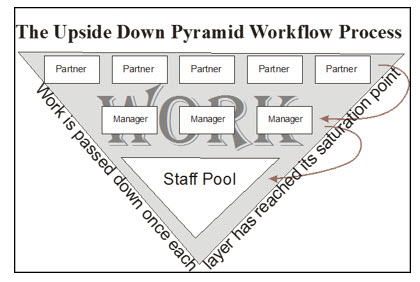 below busy is almost an afterthought. Utilizing this process, partners spend too much time doing non-partner work and staff is under-utilized, under-leveraged and often left to sink or swim regarding their development and training.
Partners Doing Non-partner Work
This workflow process can easily harm the profitability and long-term viability of the firm. For example, instead of pushing work down to the lowest possible level, nearly the exact opposite happens. Work is performed by the most experienced person possible. Although one could surmise that this approach would garner higher fees (because the work is performed by people with higher billing rates), most of the time, that assumption is wrong. For much of the work we do as CPA firms, our total fees are either fixed-in-fact or in-presumption. Obviously, fees are fixed-in-fact when a specific project price was specified. The fees are fixed-in-presumption when we do recurring work, like preparing a tax return each year, and the client assumes that this year’s fees will be similar to those charged in previous years (unless the scope of the work changed). So if you consider that much of our work is fixed in price, then using more experienced people than necessary to do the work only creates larger write-downs. If you take the position that your more experienced people do the work faster so that write-downs are not a factor, then we would respond with “We’ll bet there is higher level work your experienced people are avoiding that should be done by them instead.” If partners or mangers tie themselves up doing work that is below their capability, they are not only doing work someone else could do at a lower rate, but they are also diminishing the amount of time they can devote to work that ONLY they can do.
Under-worked and Under-trained Staff
Because it is not uncommon that firms follow a “work first, manage second” strategy, at every level of the firm, employees are left on their own to develop themselves. Therefore, just like the partners and managers, seniors and staff are often doing work below their level. The response to the idea of pushing more work down is commonly, “If I were to give this work to someone below me, I would end up spending so much time supervising them on the project that it is just quicker to do it myself.” The rebuttal from Succession Institute is “Both the roles of partner and manager are based in the philosophy that you are supposed to get the work done through others.”
Key Point: As a manager of people, that title is descriptive of your job – to manage. Otherwise, your title would be “doer.”
So the next time you hear yourself utter the words at any level in the firm, “It will take me too much time to train my people to do this,” stop and remind yourself, “Hey, it may take longer, but my job is to train the people below me so that they can do this work.” By the way, another classic reaction from this upside-down work flow pyramid is that employees rarely get feedback on their work. Instead of the partner or manager sending back a list of errors for the originator to fix, the senior people reviewing the project make corrections and get the work out the door. Once again, when this group shirks its responsibilities, the employees below them are not given the work at their level so they don’t build the appropriate competencies for their level. Over and over, surveys show that employees at every level want to have the opportunity to do challenging work, and yet firms focus on providing a volume of work without making sure that each employee is given a fair opportunity to learn and grow in their jobs.
The Solution or Reversing the Pyramid – Step 1
Reversing the workflow is a very straightforward concept: Partners must start focusing on partner-level work, which starts with managing the firm’s larger client relationships, actively nurturing new business; performing only the highest level advisory or expert work, creating and implementing strategy; and developing systems that benefit the entire firm rather than an individual. Managers must do more manager work, which is made up of overseeing the work queue, supervising and training staff, providing guidance when necessary, reviewing work and managing low-mid level client relationship. Finally, the staff is the backbone of the firm – acting as the workhorse to get the jobs done. Consider this process. When work comes in, everything that can be delegated to staff should be first delegated to staff. This isn’t a function of greed or laziness on behalf of the partners and managers, but rather, the partners and managers doing their job to siphon off any work that others can do only leaving them with the technical work that only they can do. If we don’t embrace this philosophy, then the partners and managers won’t have the time available to do those non-technical tasks of running the firm that only they can do.
Next, everything the staff can do with additional supervision and training is passed down, with the added requirement of the developmental managers actively monitoring the work. Once staff has no more bandwidth, managers can begin to perform the detailed work. This approach reverses the pyramid so that partners are freed up to spend more time building client loyalty, developing client and referral relationships and completing other strategic initiatives. A manager at one of our client firm’s said it best recently; “If one of the partners is in the office, we are not doing our jobs.” That is what we are working towards. Every firm that migrates down this developmental path starts off with partners having to do a lot of extra technical work in the office. By focusing on delegating, development and monitoring, over time, this effort will change that dynamic and allow the partners to spend the vast majority of their time doing the work partners are supposed to be doing. With the partners out developing clients and referral relationships as well as doing high level advisory work, managers have to take the lead in managing the work and developing their people. A foundation principle for reversing the pyramid is for staff to evolve at a fast pace due to the constant focus on training and improving. Therefore, the first step in reversing the pyramid is to buy into the philosophy that the culture of the firm needs to shift from whoever “does the work” being hailed as the most valuable asset of the firm to “whoever can get the work done through others by passing it down, training and managing them” is the most valuable asset of the firm.
Understand and Embrace the Critical Importance of “Learn, Try, Fail™” Cycle – Step 2
The learning process is often frustrating. So why is it so difficult to learn new things? One answer is that we don’t have “hooks” for what we don’t know (neither the mental acuity nor the physical skills). An example of this is found every time we attempt to train our people. There is a common misperception that intellectual understanding and skill development are the same. We see people regularly giving instruction to their direct reports and then walking away thinking that the employee is now capable of competently completing a task or project just because it was explained verbally. If an employee has successfully done this work before, and the explanation is simply a reminder of the steps and processes to be followed, then success is likely. However, most of the time, the person receiving the instruction is being bombarded with a combination of previously known and new information simultaneously. When this occurs, especially regarding the new information, most of it will likely come across like a fire hose shooting water” a stream of information splashing everywhere. Except in rare circumstances, a high volume of splashing information does not change one’s ability to perform. In order for our skills to improve, we typically need to go through a “Learn, Try, Fail™” cycle that looks like this:
- First, we need an intellectual understanding of what we are trying to accomplish.
- Second, we need to experience what we just learned.
- Third, based on that experience, with the likelihood of failure being some part of that experience, we can then discover important gaps in our understanding that negatively impacted our performance, and ask for updated information.
- Fourth, repeat steps two and three until we are fully competent to do the work without supervision or guidance.
As we perform steps two and three over and over in the “Learn, Try, Fail™” cycle, we are repetitively building new “hooks” to hang new information or skill upon. Repetition is the fastest way to generate new hooks. Most organizations simply provide the planning or intellectual component of the training process. Management tells people what to do and what steps to follow. Even if they are conveying that information in the right amount of detail, the problem is that they mistake the transmission of facts and data with the recipient’s ability to be able to assimilate it and do it. The recipient might have heard it all, even taken good notes, but if there are no available open hooks, all that new information may be stored in their mind, but it won’t be accessible at a level to be applied. We typically jump to the erroneous conclusion that the recipient’s successful assimilation of the new plan and knowledge equates to skill development. For skill development to occur, we need to know what we are trying to do, the attempt it, evaluate what we did grasp, identify what we missed, and then repeat over and over. With each progression of the Learn, Try, Fail™ cycle, we combine a little more knowledge and experience to create a little more skill. Don’t short your firm by losing sight of this important cycle. Put in the time to help your people build the hooks they need in order to continue progressing towards whatever competency gap you are trying to fill. And recognize that as you implement this new developmental process, that same “Learn, Try, Fail™” system is in place as we will make mistakes along the way in its implementation. This is not only okay, because that means we are trying, but it is expected, because we are trying to transfer our intellectual understanding of this process to one that we practice and master.
Putting the Development Ingredients in Place – Step 3
It is common for firms to have technically talented partners and principals. Depending on the firm’s size and organization structure, things start getting more sporadic from a competence perspective from there on down the organizational chart. For example, some firms have a strong management group with a gap in skills and experience starting at the senior or supervisor level. Others might experience their skills and experience gap at the manager level because everyone that shows any self-starting initiative or promise is moved to a principal position early on. It doesn’t matter the size of your firm, you will likely be feeling a big gap or drop in skills and experience somewhere in your organizational chart. This isn’t because we don’t have talented people. It is because we don’t provide our talented people the support they need to be as valuable as they can be to the firm.
This situation typically exists because our emphasis is less about the development of competencies and more about providing our people with necessary CPE. Development requires these six ingredients. They are:
- the person doing the work knows what is expected of them (competency model),
- the person managing the worker can consistently articulate to that worker what is expected (competency model),
- there is a developmental plan in place for each worker as to what areas need improvement and the training path to get there (both education and on-the-job training) (a formal assessment process),
- the developmental plan is based on a set of firm expected competencies required for each level of worker (gaps between assessment and competency model),
- someone is specifically assigned to make sure the worker develops according to the plan and that the plan is working and effective (assigning direct reports),
- someone is specifically accountable to make sure the worker is developing according to the plan and that the plan is working and effective (tying the performance of the direct reports to the manager's compensation plan).
Most firms don’t have formal competency models. Building one, or adopting one of the many that are available in the marketplace, allows your workers to know what they need to be able to do to perform well in their current position, as well as what they need to be able to do if they are striving to earn a promotion to the next level.
Many firms have developmental plans for their employees, but because they are not based on competencies, they are all over the board as to expectation and customized by each manager or partner to suit their individual view of what a particular employee should be able to accomplish. Where this most often breaks down is that an employee may report to multiple people with each having their own unique view and requirements for advancement. What makes matters worse is that multiple managers means no one has a real stake in the performance or improvement of a particular worker, so they get left to fend for themselves.
Everyone Needs to Report to One Boss – Step 4
This is a critical concept to embrace if you want any development system to become part of your culture. It starts with embracing the idea that every employee, for developmental purposes, needs to directly report to somebody. To be clear, every worker will report to a number of people as they are assigned to various projects. But having a boss on a project is far different than having “Only One Boss.” The purpose of everyone reporting to someone is simply accountability and consistency. The overall boss’s job is to:
- make sure the worker assigned to them knows how to do their job,
- monitor the worker’s performance (even though they will be working for many people),
- ensure that specific educational and on-the-job experiences are provided so that worker can develop according to their career pathing plan and competency expectations,
- step in and resolve conflicts or fight internal battles for their workers,
- be the final say for that worker when the direct report has been given conflicting instructions or direction by those in higher positions in the firm,
- be held accountable for that worker’s performance, with an appropriate monetary reward or punishment that performance.
As we stated above, when workers report to several people, no one is responsible and therefore no one is accountable. So workers tend to have to survive in a “sink or swim” environment. The sink or swim model of development works fine if you have 5 job openings with 100 capable applicants wanting to fill those slots. But that has not been our economic model in the past 30 years (although we came close in the 2008-2010 recession), unless you were with one of the largest accounting firms. For as long as I can remember consulting with firms, every one of our clients has said, “we need to hire a (or many) 10 year people …,” and for as long as I can remember they haven’t been able to find even close to the numbers of experienced people they have been looking for. Today, that comment usually starts with “We need to find several people with 3-4 years of experience” and then the firms list many more positions they are trying to fill at every experience level above that. The point is … no one can find these people, except as a fluke (like someone returning back to their home town or transferring because of a spouse). And often the people they find on the market, which still are not enough to fill the existing capacity gap, are the “job hoppers” who look good on resume but basically get run off after about 4 years due to performance issues. So, that leaves all of our firms with the same solution; hire right out of school and develop them quickly. This means that our future success is predicated on our ability to develop people faster than we ever have, and develop them better and stronger than we ever have. The most assured way of accomplishing this is to have each of your people report to one person as his/her developmental supervisor/manager.
I think it is necessary to reiterate again that we are NOT suggesting that everyone should only perform work for one person. In CPA firms, we use matrix management constantly meaning that depending on the project, anyone could be working for almost anyone. And while working on a particular project, I will have a boss – whoever is leading that project. But as soon as I -- as staff -- can’t get my work done, don’t have the skills to do the work being assigned to me, am being directed to do things in opposition of my development plan, then I need to know who my boss is and let them resolve my issues. When everything is going well, the workload I am expected to accomplish can easily be done during a normal work day, I have the requisite skills I am supposed to have to do the projects I am assigned to, I don’t need to have just ONE boss. I can just do my job and work for whoever is leading the project I am assigned to. But the fact is … that situation is not the norm. Often things are chaotic in CPA firms, the workload I am required to accomplish can’t be done in a normal day and I don’t have the skills I need to do the level of work required to fully perform at my level. And during these times, having “A Boss” is critical if you want to keep my morale and performance high. So someone, meaning only one person, needs to have the job to make sure I understand what I need to accomplish, what my expected work hours should be, and most important, make sure I am given the training and oversight (monitoring and feedback) necessary so that I can live up to the competency expectations of my current job as well as prepare me for my next one.
Create Developmental Managers, Their Role and the Organizational Chart – Step 5
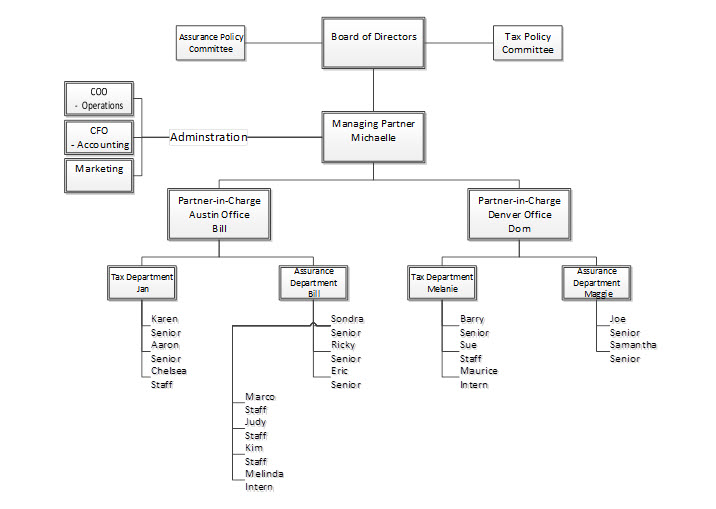
This next step is to develop an organizational chart where it is clear who is responsible for developing whom. In this chart, you might have people listed multiple times as that person may be in charge of a department and then show up again as being the specific developmental manager for specific people. For example, looking at the chart below, Bill is in charge of the Austin office, which mean Jan and Bill (yes, the same Bill) report to him. But Bill is also the leader of the Assurance Department, so that means in that role, Sondra, Ricky and Eric also report to him. Michaelle, as the Managing Partner of the firm, not only has Bill and Dom reporting to her, but so does Administration, which includes the COO, the CFO and Marketing. Drilling down to Sondra, who reports to Bill as the department leader of Assurance in the Austin office, she has Marco, Judy, Kim and Melinda reporting to her. The point is … everyone reports to someone for development, which we will get more into those job roles in a minute.
But before we go there, understand that laying out this organizational chart takes a lot longer than everyone thinks. It is normal to work through this three or four times before a firm finally get to a picture they like. While many people don’t need to have anyone reporting to them for developmental purposes (although many of those people in CPA firms will constantly have people reporting to them on a project by project basis), everyone needs to show up with only one person as his/her direct boss.
So, what does this direct boss do? As you can see below, a number of things. The Developmental Manager (we are not referring to the function of managing people, not the title in a firm of manager) is:
- assigned to make sure the people reporting to him or her get better;
- responsible, for each person reporting to them, to determine what competencies each person needs to develop to do their current job (in other words, assess each person’s strengths and weaknesses related to the firm’s competency model and make sure each person has a development plan to obtain a minimum level of skill and experience so that they can satisfactorily function at least at the minimum level across all competencies the firm expects for that position);
- responsible for setting the annual incentive goals for each of their direct reports;
- responsible for monitoring frequently, with formal discussions as to progress, how each person is performing against those goals (at least once a quarter, most likely very short meetings once a month);
- expected to regularly review and assess personally enough work for each direct report to be able to determine whether each person is getting access to the right and necessary experience required to develop the skills expected to performance their job. This evaluation would result in the identification of additional training, specific niche areas of training, general and specific niche experience each person should be exposed to, coaching and more to insure that each direct report is progressing in their development plan;
- tasked to reach out to those in charge of scheduling as well as project managers supervising the developmental manager’s direct reports on various projects to request specific job training or experience to be provided to their direct reports;
- tasked with stepping in and resolving conflicts that arise with their direct reports. A common conflict is that a direct reports will be pulled in too many directions by numerous project managers and can’t get all of the work done (which are often partners, principals and managers with the firm). In these cases, the direct reports are to come to the developmental managers so that the developmental mangers can resolve the work overload or deadline expectations. In other words, when a direct report is put in a position where he or she doesn’t feel they can do the job asked of them, either because of time available, timing of the project, skill/experience needed, etc., the direct report goes to their developmental manager for a final decision as to what to do (which means that the developmental manager will likely have to get with a partner or principal and work something out). But to be clear, the direct report has one boss and when conflicts arise, the direct report goes to his or her boss for direction and when appropriate, the final decision. The developmental manager becomes responsible for finding a solution;
- responsible for the evaluation of all of their direct reports based on the accomplishment of those goals. While the developmental mangers need to seek input from other people who worked and managed their direct reports on various projects throughout the year, the developmental manager is the only one responsible for making the final evaluative recommendation to their boss (the developmental manager’s developmental manager);
- partially – but significantly -- evaluated and compensated based on the performance of the people they directly supervise;
- expected to council out or terminate, with the added approval of their developmental manger, those direct reports who are not and cannot achieve the minimum level of competency across all of the expected competencies for whatever position the direct reports hold;
- charged with making bonus and salary change recommendations for each direct report based on each direct report’s development progress and job performance; and
- responsible for mentoring their direct reports to get them prepared to be promoted up to the next level in the organization.
As you can see by the list of expectations above, being a developmental manager requires time. And that time needs to be spent understanding, monitoring, proactively guiding training and experience opportunities, coaching, evaluating, rewarding and when necessary terminating those people who report to them.
It should be no surprise to anyone that very few people in a CPA are currently fully prepared to step into this role. The vast majority of CPA firms don’t even have a culture that supports this level of development, and even those who do with rare exception have delegated enough authority and responsibility to their developmental managers to carry out their charge. And then even fewer, or better said almost none, reward their developmental managers in a substantial way based on the performance of their direct reports.
For all of these reasons, we suggest that you start this process out slow, lay out the plan with the entire firm, but role this out in small groups to make sure you fine tune the process and expectations. For example, if a developmental manager has 5 people reporting to him or her, and they believe 4 should be fired, then the odds are very high that the developmental manager is the one that doesn’t know how to do their job. So, this means that each firm needs to work closely with the developmental managers to insure those people know what they are doing, and are actually doing the job, before turning over the full authority and responsibility of the role to them.
Make Sure Your Developmental Managers have the Right Tool Kit to do the Job– Step 6
The developmental manager needs training. In our experience, most people don’t know how to manage people in our profession; they know how to manage projects. There is a difference. Make sure the developmental manager receives help in learning how to manage and develop people. Spend time and resources giving them training in this critical, foundational skill. The Situational Leadership® training is a great starting point. This is a management course developed by Dr. Paul Hersey and Dr. Ken Blanchard, based on Hersey’s best-selling book called Situational Leader, which really created the field of organizational development.
Make sure the people you charge with development have some time set aside to perform the important process of establishing expectations, creating action plans, monitoring performance, and providing timely feedback (“timely” can be considered, at maximum, every 90 days, but more frequent feedback is far better). Don’t confuse this feedback process with HR compliance. This is developmental activity that needs to be ongoing and consistent. As well, the developmental manager should not become totally administrative in nature. For example, if we are setting expectations for a technical manager in a firm, we might expect 1,500 chargeable hours (because they basically don’t develop people except by teaching them technical skills or giving them on-the-job work experience on the projects they manage). However, for a developmental manager, maybe 1,200–1,300 chargeable hours is right, depending on the developmental load.
When appropriate, leverage tools such as a 360° assessment to provide additional insight regarding performance for the person being developed as well as to the developmental manager.
Someone needs to provide oversight to anyone in the development role. In CPA firms, it is easy for developmental managers at every level to get overly focused on charge hours and put off the developmental efforts until they have free time, which is often never. Oversight must be provided to those who are charged with people development to ensure that
- competency expectations are being shared early and often,
- action plans are being timely developed and communicated, including external and internal training, along with on-the-job exposure to experience-based learning,
- frequent monitoring activities are occurring, and
- timely feedback regarding performance is being provided, with action plans being updated and communicated at appropriate intervals based on progress.
This process closes competency gaps at and between every level, creates talented capacity at every level, and builds an army of personnel that are better, faster, and stronger much more quickly.
Another point to consider is that not everyone is suited to develop people, and even if everyone you have is suited for this role, it is not effective or efficient to get everyone involved in this process. For example, if you have 3 managers and 8 staff, the normal approach most firms would take would be to divide the people between all three managers. However, in our opinion, assuming all three managers are in the same specialty area (like tax) and all 8 people mostly work in the tax area, one manager can be the direct boss of all eight of them. This creates efficiency in the process of developing others, generates consistency in the developmental plans and allows the firm to leverage the best people developers among their group of managers. This same story is consistent as you move down the organizational chart. One supervisor can manage a number of seniors. One senior can manage numerous staff, and so on. General management theory says that when a person starts managing around 10 or more people, their span of control is starting to get to wide to adequately monitor their activities and process with a reasonable level of frequency. So, when someone is assigned too many people, management effectiveness starts to fail because that manager is responsible for too many people without adequate time to manage them well.
Finally, as mentioned above numerous times, create (build your own) or adopt (use a third party’s model and maybe tweak it a little to work with your firm) a competency model for the various levels of people within your firm. If you want your developmental managers to effective, and more important, consistent, in the way your people are trained, everyone needs to be working with the same expectations. This means that each developmental manager does NOT get to pick and choose what is expected of their direct reports at each level, but rather, are held accountable to developing exactly what the firm has decided is important for its people at each level to be able to demonstrate.
Recognize that once you have a competency model that you are using, it is important to establish minimum levels for each competency as well. For example, while everyone has strengths and weaknesses, and we want to leverage our people’s strengths and minimize the impact of their weaknesses, at what level is someone’s weak competency acceptable versus being too low to even meet the minimum standard.
Having Firm-Wide Accountability is a Requirement – Step 7
Accountability leads to accomplishability. Accountability is a simple concept under which people are held responsible for their work, but few companies implement accountability effectively.
Real systems of accountability are fundamental to any successful business operation. Accountability attempts to remove a great deal of the common subjectivity currently found in evaluating partners, managers, staff or quite frankly anyone’s performance. The only way anyone can rest easy about what he or she actually accomplishes is by knowing what is expected, that there is a system in place to measure that performance, and that the system is objective as much as possible and fair.
Clear Expectations
How do you inform people of their exact job responsibilities? In most firms, the managers only give each employee a vague insight into what's important, and the same is true of partners to managers and the managing partner to the partners. The beauty of this system is, when it comes time for an evaluation, depending on the evaluator's subjective feelings at that moment, the individual being evaluated can be rated anywhere from inadequate to superhuman.
When I ask management why a system this imprecise continues to be used, the common reply in confidence is, “This system gives us maximum flexibility. We don't want to be pinned down to a specific job expectation. What's important changes hourly around here. And we don't want anyone hiding behind some established job description. I don't want to hear ‘That's not my job.’”
This management response is exactly why many employees (for the rest of this section, the term “employee or employees” is shorthand for partners, managers and staff of a firm – anyone that reports to someone else) feel insecure about their performance. When an employee doesn't know exactly what is expected, then, regardless of the quality or quantity of the work done, he or she can't feel satisfied. However, when a job is well defined with expectations clearly explained, an employee is empowered with two important tools. The first tool is self-evaluation. Employees can more easily go home feeling good about what they have accomplished when they can compare what they have done with what was expected. The second tool is defense. At evaluation time, the employee doesn't have to become a casualty just because his or her management is having a bad day. Instead, the manager is forced to judge performance based on facts, not emotions.
How do most firms outline job expectations? Formally, this is most often done through job/position descriptions. Position descriptions should be a two-way negotiation. The manager has specific job functions to be performed, and the employee offers certain skills and talents. The position description is a short-term contract outlining what is expected. Not everything asked of an employee has to be listed in the job description, but the primary day-to-day, month-to-month time-consumers should be clearly identified.
Another example of “management not wanting to be pinned down,” almost opposite of job expectation, is company policy. Many companies like to be "precisely vague" in order to achieve maximum flexibility in this area. Consider, for example, the following company benefits scenario:
A company continues to grow and prosper, but is reluctant to formalize many of its policies for fear they will be taken advantage of. In order to meet the workload, employee number 27 is hired. He works well for the first six months, but by month seven, he is calling in sick on Mondays. By the eighth month, employee 27 is occasionally calling in sick on Fridays too. After several counseling sessions, and a couple more passing months, a meeting is called to establish a sick policy (especially after the management team found out how hard it is to fire someone for excessive sick leave). The company creates a policy that allows each employee to earn one-half day paid sick leave for every month worked, up to a maximum of ten days. In addition, a tardiness policy is established and a committee is formed to determine how deter excess absences.
Who in this scenario won by maintaining informal unclear policies? Was it the employees who had to continually perform number 27's work? I think not. Was it the employees who never abused the policy, but now are limited to ten days? I think not. Was it the company? Not a chance. Was it employee 27 who now gets one-half day for every month worked plus the twenty days he has already taken? You bet. Fair treatment is important in managing and motivating the workforce. And in this example, which is hardly rare, the flexibility that management wanted to maintain by not setting clear expectations almost always leads to the unforgivable abusing-of-the-loyal.
Objective Performance Measurements
A critical step is to be held accountable, as much as possible, to performance measurements that are not purely subjective. What does this mean? To most employees, it means there is a defined way to fire the non-performers. When you talk about this concept, almost everyone supports it. However, in practice, the closer to actual implementation, the more nervous everyone gets.
Why? Because it is a rare individual who knows he or she is one of the non-performers. We all can identify those whom we perceive do less than we do. But the general lack of trust between management and employees becomes a definite factor as accountability systems are implemented. And employees have good reason to be concerned.
Ranking (which was widely adopted in the early 90s) is a good example of a system meant to destroy any idea that objective measurement is management’s ultimate motive. This system revolves around each manager ranking their employees as to who is most to least beneficial to the company. This approach has backfired over and over as managers were given a power and responsibility they weren't ready for. Good employees would be placed in "cut" positions because of their rank, and marginal employees that were friends of management were thrown brand new full-featured lifeboats (not life-vests) just as they were about to drown from their own marginal efforts. The system often failed because it didn't adequately address issues like:
- was a low ranking indicative of being a bad employee?,
- if everyone in a particular department was exceptional, how meaningful was ranking?,
- how much did the personal relationship between a manager and employees affect the ranking?,
- could a person ranked last in one department be a significantly better performer than someone ranked first in another department?,
- how much did the actual work performed affect the rank? For instance, some work is routine, other work unique. How did ranking consider the person's value to the company relative to the work assigned? etc.
Anytime performance measurement systems can’t stand on their own objectivity, people immediately begin relying on relationships for survival. This creates a bad situation because employees working in relationship-centered, rather than performance-centered organizations:
- are constantly insecure about their jobs.
- have an overactive communication grapevine (gossip runs rampant),
- suffer morale problems due to excessive employee positioning (people stepping on each other to make sure they stay in good graces with their manager), and
- are often inefficient because they spend too much energy playing politics rather than working.
To avoid these negative effects, managers need to provide employees with information such as job requirements, expectations, and performance feedback. This lays the foundation for a performance-oriented organization.
Whenever possible, job performance should be based on outputs rather than inputs. For example, working eight hours in a day is an input. Producing a specific report is an output.
Accountability is also facilitated by management's understanding the difference between setting goals and making employees accountable. Management is all too often confused by the Army slogan, "Be all that you can be." We don't seem to be able to distinguish between motivating employees to stretch their capabilities and making them accountable for the work they perform. If you don’t believe me, answer these questions before continuing. “How high should you set your employees' personal goals; easily within their grasp or just out of reach?” “Where do you establish minimum acceptable standards; at a level of accomplishment just above showing-up for work or unique to each individuals capabilities?” Consider the following story:
Tom is the budget master for the organization and is considered one of the best employees in the controller's department. Last year, he worked an average of 55 hours a week and did high quality work. Now, a new year is starting. The organization follows a "management by objective" philosophy. Therefore, it's time to determine what you expect from Tom over the next twelve months. Because Tom is such a good employee, and because you hope he will take over your job when you move up soon, you want him to stretch his capabilities. You believe that goals should be set at the furthest reach of an individual's grasp to achieve the highest level of performance. So, you set lofty goals for Tom, and naturally, tie in some nice performance incentives.
After you review your plan with Tom, you quickly see that he is taking your objectives in stride and is stepping up to the challenge. He puts in more than sixty hours a week, doing better work than he has ever done before. However, at year-end, he falls a little short of the targeted objectives.
So what do you do? Most managers tell me (in group settings) that Tom would not earn his performance bonuses. Why? Because he did not achieve the stated objectives. But, first, remember that the goals were lofty in the first place. Second, you were trying to give Tom a work target that would stretch his capabilities. Third, he is one of your best employees. So after he puts in a record year, your response is that “he wouldn't receive his bonus.” If this is your modus operandi, by now, you should have run off every good employee you have.
Most companies in this situation do one of two things; both are bad. The most common response is to restructure the goals (or move the bar) so that Tom's actual level of accomplishment allows him to attain the new objectives. Thus, he "earns" the performance incentives. The second option is to deny Tom the original incentives and then come up with some bogus reward to compensate him for any shortfall resulting from the denial of performance pay. Given this, let’s continue with our story:
It's objective-setting time again and because you were so generous last year, you really want Tom to earn his keep. You tell him this up-front. You set exceptionally high goals for the oncoming year because you want him to really learn the ins-and-outs of doing your job. Tom makes a valiant effort too. His average work-week is 70 hours. But still, Tom falls short of most of the outlined targets at year-end.
What do you do? Once again, you are likely to make good on Tom's compensation, even though technically he hasn't earned it either year. Why make these exceptions? Because Tom is too valuable to lose. He is also the highest work contributor in your department. So the saga continues:
In year three, Tom is burned out. He has decided that to avoid divorce he must spend more time with his family. While Tom still performed quality work, he only put in about forty-five hours a week. Therefore, his output was significantly lower. By year-end, Tom wasn't even close to his annual targets.
So what do you do this year? In almost every case that we have presented this scenario, management around the country has concluded that Tom should receive “no performance bonuses.” Their reasons were numerous. A couple were:
- Tom missed his targets by too great a delta,
- Management was unwilling to break the rules for the third year in a row based on Tom’s marginal performance,
- Management felt that Tom didn't try hard enough (or had a bad attitude towards work),
- Tom performed significantly less work (while still quality work) than he has normally done, and more.
Management’s rational: the system in place clearly calls for Tom to be denied performance pay. And because of his marginal output during the year in question, there was no reason to create some special compensation reward.
Now, let's step back and see exactly what we've taught Tom about accountability. NOTHING! This system, which exists in organizations throughout the country, makes it clear that what Tom does is not as important as your attitude towards what he does. And anytime you mix "Your Attitude" with "Employee Accountability," you come up with "The Good Ole Boy System (it's not what you do that's important, but who you know).” Accountability has to be firmly entrenched in ideas and ideals like:
- Each employee should know exactly what he or she is accountable to perform,
- Whenever practical, the results of each employees work should be objectively measured and monitored,
- Employees should be able to easily assess whether they are meeting or exceeding expectations,
- Performance measure bars should remain constant and not shift with the wind,
- It is up to the employee, not the manager, to ensure that the proper levels of output are achieved,
- While personal growth goals can be customized to each individual’s capabilities, performance measures should be based as if the “generic” or average employee was filling the specific position,
- Achieving less than the organization’s minimum level of performance means the employee doesn’t get to keep his or her job (these bars should be set at minimum acceptable standards, not what we commonly do today), and
- Incentive systems need to be in place to reward those achieving output results at various levels above the minimum expectation bar.
In Tom's situation, only the first three of the key factors listed above were present. In addition, performance measures were established to push the capabilities of that particular individual, not the job position. Tom’s personal growth goals could have easily been the same as identified above. However, the minute those lofty personal goals were tied to incentives, the system was doomed for failure. Pay for performance is about paying people for the difference between the minimum level of performance acceptable for a job versus the level of performance attained. If someone is falling short of the minimum level of performance, the discussion should be about whether that person will be able to keep their job. And the delta between over-achievement and minimum expectation is “paying for performance.”
One more thought on this that is commonly confused. You can create some objective metrics that surround subjective expectations. For example, if someone loses control when around their people and inappropriately yells at them, then an objective measurement tracking that person’s level of self-control is to create a time code for people to book time to whenever someone is treated so badly they go home crying because of inappropriate interactions. And everyone in the department is also supposed to book time to that code when they end up spending time consoling someone for those outbreaks. Then look at the total hours accumulated as a way to take a subjective issue and frame it with some objective numbers. Another example might be something like delegation. Did someone delegate more? Well, have the person tasked to delegate more keep a notebook or online diary listing each instance where work was delegated that he or she did the previous cycle (last month, last year, etc.). The point is … for many subjective issues, you can get creative and come up some at least some way to generate a little more objectivity around it, even if it is as simple as meeting with someone and talking with them every week for 15 minutes about an important improvement area. Techniques and interactions like those mentioned above are just examples of creative ways to put a little bit of objective support behind an otherwise subjective expectation.
Accountability is not passive. Accountability requires a change in the philosophy of most cultures. It demands that everyone be and feel more empowered regarding their performance. It is up to the individuals to keep their jobs, impact how much they earn, determine how much work-product they produce, and so on. It is up to management to become the resource to help those who want to help themselves. If a partner, manager or staff wants to perform just at the minimum bar, that's fine. Don’t kid yourself, firms everywhere have a lot of employees that are “minimum bar” producers. Meeting the minimum level, which that effort should earn the minimal level of pay, is totally acceptable. But the fact is … in most firms … you have people that have not met the minimum levels of expected performance for years at every level, maybe a decade, and nothing has been done to rectify this. Accountability, coupled with developmental managers, will resolve this in very short order. And accountability is for everyone, from the managing partner reporting to the board of partners, to the line partners reporting to the managing partner, and for every other level within the firm. Accountability has to be implemented firm wide and has to start at the top and trickle down from there.
Creating a Developmental Action Plan – Step 8
Now let’s move on with an example of what a plan might look like. We have created a sample action plan to walk you through on one area for improvement to simplify this discussion. Some people believe that action planning and identification of measures of success are difficult activities. Hopefully we will dispel that notion with this brief explanation. Take a quick review of the action planning Excel worksheet below and then we will get into the details of how to decode it.

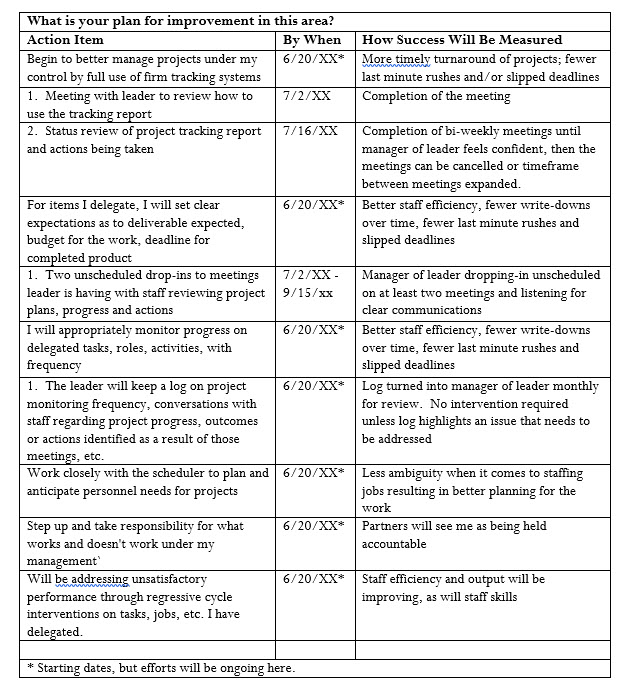
We patterned this after the Succession Institute’s competency model, but you can use a model you developed internally or one you acquired from other sources. But regardless of the model used, the approach is still the same. As we walk through this spreadsheet, we will show you how easy it is to create action plans and identify measures of success.
At the top of the form, you’ll see that we’ve chosen the competency area of “Execution” to pursue for improvement (we chose that because our assessment process unveiled that this was a problem area). This was a red zone area – a competency area that was highlighted for attention for a particular partner in the 360 feedback received from the managing partner, partner peers and direct reports.
Next, we look at the definition and scope of this area. According to our competency model’s resource guide, Execution is all about setting clear, realistic goals, possessing an unwavering resolve, demanding results, and the like.
Continuing on through the form, we see a listing of some of the capabilities we can expect to find in leaders that perform well in this competency area. Next, we will pull from our competency assessment any statement areas that show low scores as these are ripe for improvement and change. Normally, we consider a score to be “low” if half or less of the total responses agreed or strongly agreed that the leader exhibits that behavior. In this case, the leader only scored above 50% on one item (that was “having an unwavering resolve to achieve goals”). But because of the generally low level of scoring in this area, and because 55% is borderline anyway, we listed this behavior as well even though it’s higher than 50%.
All we’ve done thus far is simply gathered and organized information from the competency model’s resource guide and the assessment/evaluation process. Now we need to do some thinking. If you are new to this or you have an unusual situation, you might find it valuable to get some sounding board help and clarification assistance from our boss, a trusted colleague or two, or a consultant. What we’re trying to determine here is: what’s going on? What might be some causes of the negative behaviors that are being seen? What do we need to do differently to be more effective? And what can we do to strengthen desired behaviors and limit undesired behaviors?
If you look at Execution, it’s about setting clear goals, letting people know specifically what their assignment is in achieving the goals, and monitoring performance to be sure that the goals are being met. In the event that goals or deadlines are missed, we need to be having discussions to determine why and address the causes. This is all about effective delegation and project management. But sometimes after you have done your analysis, you might find that this person is being blamed for inheriting the problems others have caused, like a partner committing to unreasonable dates, fees, etc.
Assuming this is not the case, the managing partner and this partner have identified some simple steps that can be taken to improve performance in this area. By the way, it is always a good idea to allow the person being evaluated to come up with some ideas as to how to improve before you, as the leader, finalize the action plan. These actions will be continued through the next evaluation period. The first action listed is to use existing firm resources to better track projects under his or her management. If the firm didn’t have a satisfactory system, this action item would be to create a process to better track his or her projects. If you can’t track the projects, how will you know if they are progressing as planned or if you will hit your deadlines? As to measures of success, a reasonable and intelligent person should be able to tell if last minute rushes are decreasing, if projects are turned around more quickly, or if deadlines are being met. But you might also include a meeting in the next few weeks with the worker to verify his/her understanding of the project tracking report. As well, you might set up a meeting to review the tracking report every couple of weeks until you are confident the report is being used properly and that actions are being taken timely.
Next, the person being evaluated and looking to improve will begin being more clear at the outset in his or her delegation, setting clear expectations of what is to be done, by when, and within what kind of time budget. How will we know if this is working? We should see better staff efficiency, fewer write-downs, fewer last minute rushes and a decrease in missed deadlines as a result of this. We can also sit in on a meeting or two between the leader and staff on various projects to hear first-hand how clear this information is being conveyed.
But that’s not all that it is required to execute effectively. Our leader will need to be closely monitoring delegated activities and tasks at the appropriate frequency, to hold others accountable and assure that plans are met and deadlines are met. How do we know if this is working? The same success measures as we identified for the previous action item should also work well here. We could also request that the leader keep a log for a period of time as to how often this monitoring took place, how those conversations went, outcomes or actions taken as a result of those meetings, etc. It is amazing what happens when people are asked to keep logs – they become more aware of how infrequently they are doing what they are supposed to be doing. One word of warning … we are talking about steps you might take to improve a skill or capability. You will likely see quick improvement with this heightened awareness and focus. But don’t make the common mistakes we as accountants make and take a good technique and overusing it. For example, don’t make people keep logs on everything or you will find the technique losing its impact and you will end up creating a bureaucracy that will become an administrative burden and hurt your overall production.
As you read through the action items, you will see that each is very straightforward. Actions plans should be as simple as possible and when logical, have some kind of review date scheduled, output expected or something that allows the person being managed to communicate their effectiveness or changes they are making. We use this next phrase often during our action planning coaching process, “Please help me come up with something that allows you to clearly communicate with me how well you are doing on this. I am looking for ways to give you credit for whatever improvements you make, but I need a way to monitor or verify your performance so that I can give you that credit.” And we mean just that … we want our direct reports to be successful, but we can’t manage their evolution unless we come up with ways to monitor it that don’t create an excessive administrative burden for either of us.
Note that the measures of success refer to outcomes. Action items are the inputs, and measures of success identify the outputs—what should happen if you carry out your actions. These plans indicate that the leader is looking for increases or reductions in certain things. You could take the measurement process a step further and indicate how much of a reduction in write-down you are looking for, say a 10% reduction in write-downs. Further, you could start “exception” monitoring and say that you want “2 or less” missed project deadlines in a given period for example. So clearly, we did not try to take our example to that level, but we easily could have.
Part of being accountable and holding others accountable involves identifying how we will define success. Some definitions are qualitatively measurable, while others are more quantitatively measurable. Don’t make this part harder than it needs to be. Look for what you want to change as a result of your action steps. That’s what you want to measure to be sure that what you’re doing is working. It’s that simple.
Finally, we just want to point out that, from a simplistic point of view, you could create the action plans with only one basic outcome required -- that the leader raises his or her evaluation scores in the specific identified areas to meet minimum criteria. As always, keep in mind that you need to customize your action plans and measures of success to meet your needs and fit your circumstances.
Conclusion:
We hope this document has provided some food for thought on how to develop your people more quickly to be better, faster and stronger. The kind of changes we have been describing will not only over time build a stronger firm and put more money in everyone’s pockets, but it will lessen the current performance pressure on everyone throughout the firm. The implementation of this process, just like everything we do that is new to us, will go through the iterative cycle of “Learn, Try, Fail™.” Don’t be discouraged as you see failure or people struggling to implement these changes, but be encouraged by the fact that everyone is pushing themselves to get better and that this environment is rife with failure. But failure is a sign that someone is trying something new or trying to push their boundaries, which is exactly what will make your firm the best firm it can be. Good luck in pursuing this exciting developmental adventure.
Download
| File |
|---|
| Developing People Faster Takes a Different Approach |

We help organizations implement their unique strategies by:
• Working with them through the tough issues, and
• Customizing responses to address root causes, rather than merely treating symptoms.